The W1M Investment Barometer – January 2026

History is said to rhyme but not repeat itself; investors will be hoping for no repeat of the extreme volatility seen in the first half of last year caused by the imposition of significant US tariffs on imports which led to fears of higher prices with weaker growth (i.e. stagflation). There was, however, a rhyming with the past in which the gloomiest commentators were perhaps disappointed by the resilience of the US and global economies, as well as excitement about “AI” earnings prospects, which led to equity markets bouncing back to around all time highs by the end of 2025. Gold was also up strongly with investors increasingly interested in real assets and the diversification they offer. Bond markets remained watchful regarding inflation risks but constructive in expecting modest US and UK interest rate cuts in the next twelve months. Market movements in 2025 and geopolitical events already this year have underlined the need for investors to be properly diversified, global and active, both to make positive returns but also to control risk.
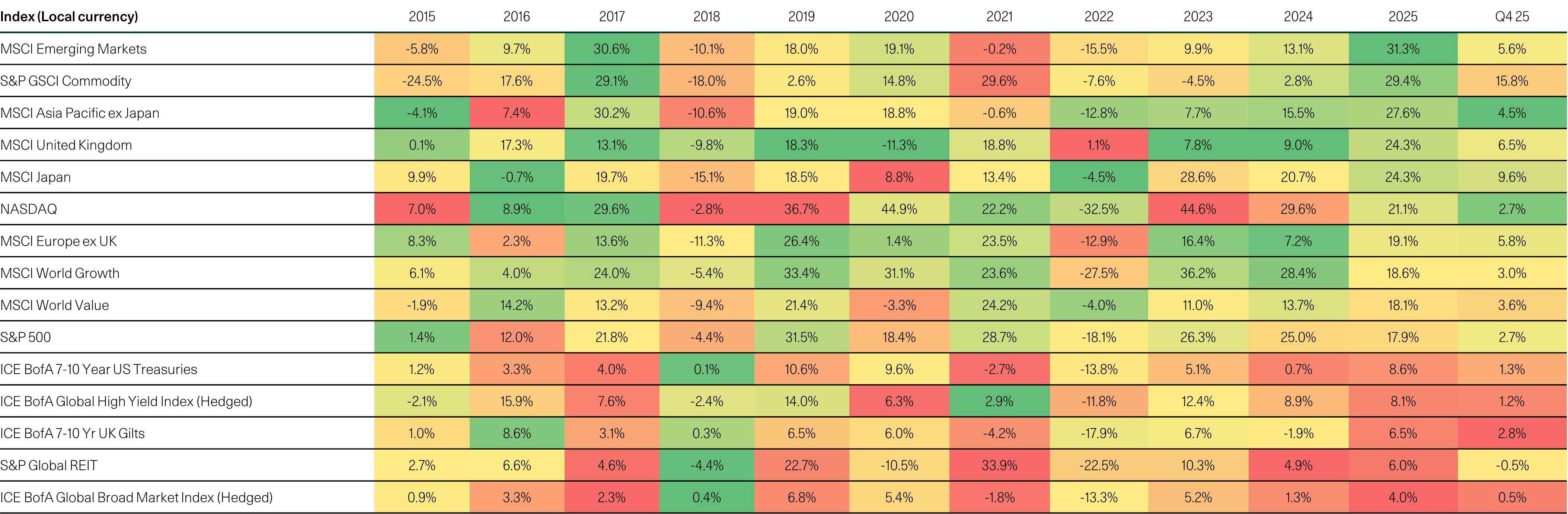
Risk Warning: Past performance is no guarantee of future results and the value of such investments and their strategies may fall as well as rise, you may not get back your initial investment, capital security is not guaranteed
Source: W1M, MSCI, Bloomberg
Tariff shocks have not resulted in the stagflation feared…so far.
The US election was won largely by promises to end illegal immigration but also partly on the idea that huge US trade deficits ($918bn in 2024) resulted from there being no level playing field in global trade; it was asserted tariffs could fix that imbalance. Voters, and American unions, like that idea; it is one of the few ideas that unites the left and right there because the EU and China also place tariffs on American exports and have enjoyed decades of large trade surpluses with the US. Trade deals were not made in time, tariffs were imposed and remain in place; there has not really been any “chickening out” as shown by the US government now collecting around $30bn a month in tariff revenue and there is a negative impact on the profits of exporters to the US.
Markets were shocked by the scale and extent of tariffs imposed last Spring; they were considered by many to be both inflationary (as companies face higher costs) and negative for growth as consumer’s tend typically react negatively to higher prices. The global economy, however, grew around 3% in 2025, but with the US continuing to outperform Europe significantly (as it has this century with the Eurozone going from around the same size to being a third smaller than the US economy in GDP terms, despite having a larger population). China has shown greater resilience, having moved up the value chain successfully, and is leading in some technologies now, as reflected in stocks held within W1M portfolios, but is seeing some negative impact on export prices; this shows perhaps why inflation has not been as much of a problem as some feared given exporters are not (yet) passing on all of the costs of tariffs they now face. With that sharing of tariff costs by exporting companies, prices to consumers are not rising to fully reflect tariffs so far, the inflation outlook remains constructive for the US and UK, with bond markets in both expecting one or two further small interest rate cuts in the next 12 months.
There are still lingering tariff related questions: Who will pay that $30bn a month being collected in tariffs in 2026 and beyond? Will multinationals and exporters take a permanent hit to their profit margins or seek to pass on more costs to customers? Will US consumers, in the end, bear most of the cost of tariffs? It is obviously important to be invested in companies which have the ability to maintain and improve their profitability and avoid those which struggle to increase prices or have to cut them in competitive markets; actively invested portfolios have the opportunity to choose the former.
In addition to tariffs and stagflation risks, geopolitical issues remain and perhaps have already grown this year; it is obvious that soft power is not as important these days as hard power; perhaps it never was. With the US mid-term elections only three quarters away now, it may be reasonable to expect no US policy initiatives which could panic markets as “Liberation Day” did last year, but other countries are unlikely to be constrained by that factor. In the end, markets are not necessarily driven by geopolitics but by the scale of impacts seen; i.e. whether global growth is positive, companies can increase their earnings and interest rates are falling - or not. Last year was a good example of markets reacting in fear short term but in the end recovering because those key fundamentals remained supportive.
Growth: company earnings are expected to be positive
Global earnings growth estimates 2025-27
Earnings per share calendar year growth rate
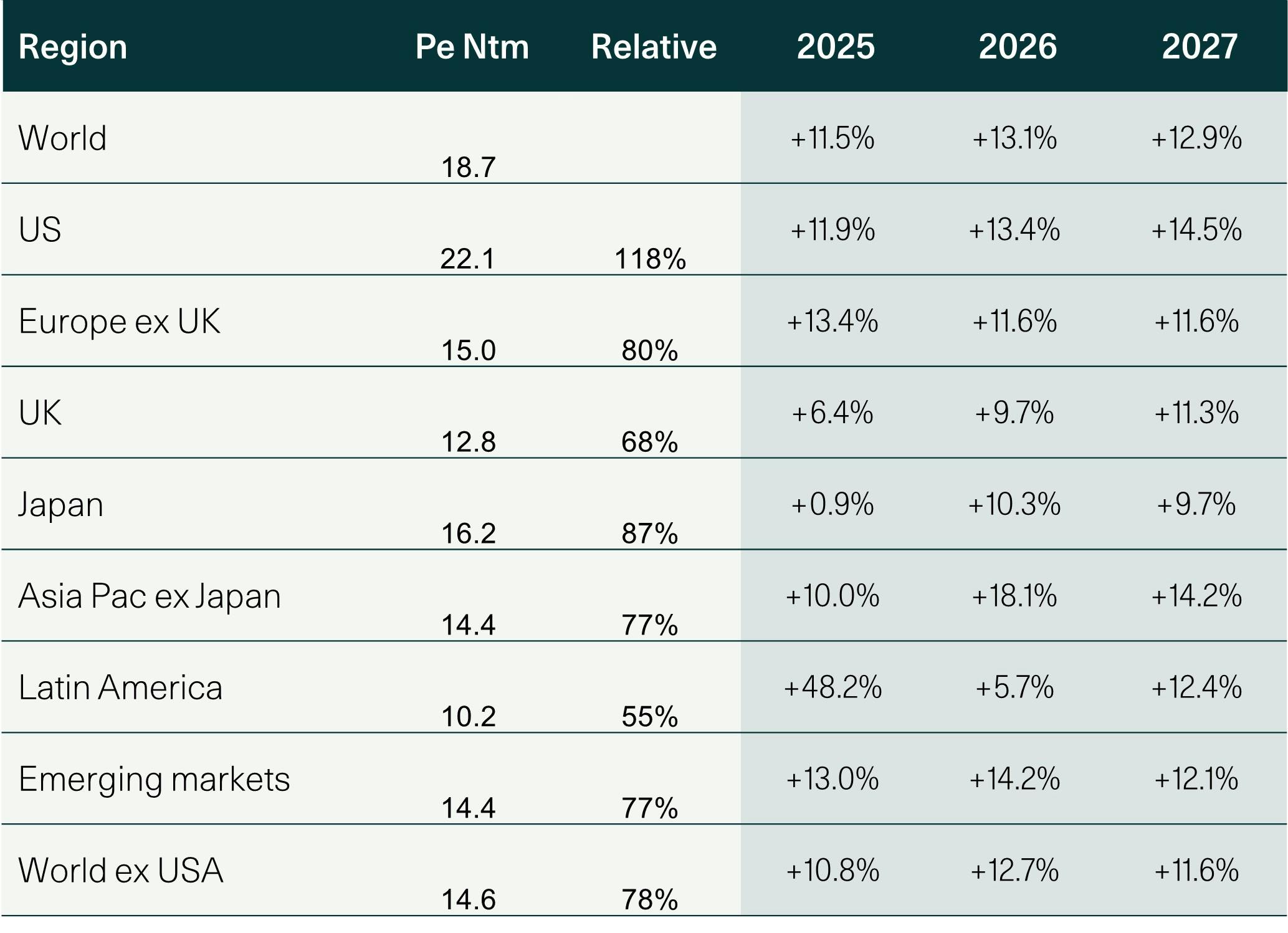
Source: MSCI, FactSet, W1M. Data as at 20.11.25
Inflation and interest rate expectations
Bond markets are quite constructive on inflation being benign and are expecting modest interest rate cuts in the US and UK. This is positive for fixed income but also shows some caution on potential inflation resilience this year as fewer US rate cuts are expected than were priced in last summer. But still, rate cuts are better than no rate cuts or expectations of increases. If UK inflation falls towards its target levels, as expected, UK government bonds could enjoy a meaningful rally and we retain a preference for gilts over credit.
US and UK potential interest rate trajectories
Implied UK Base Rate (%)
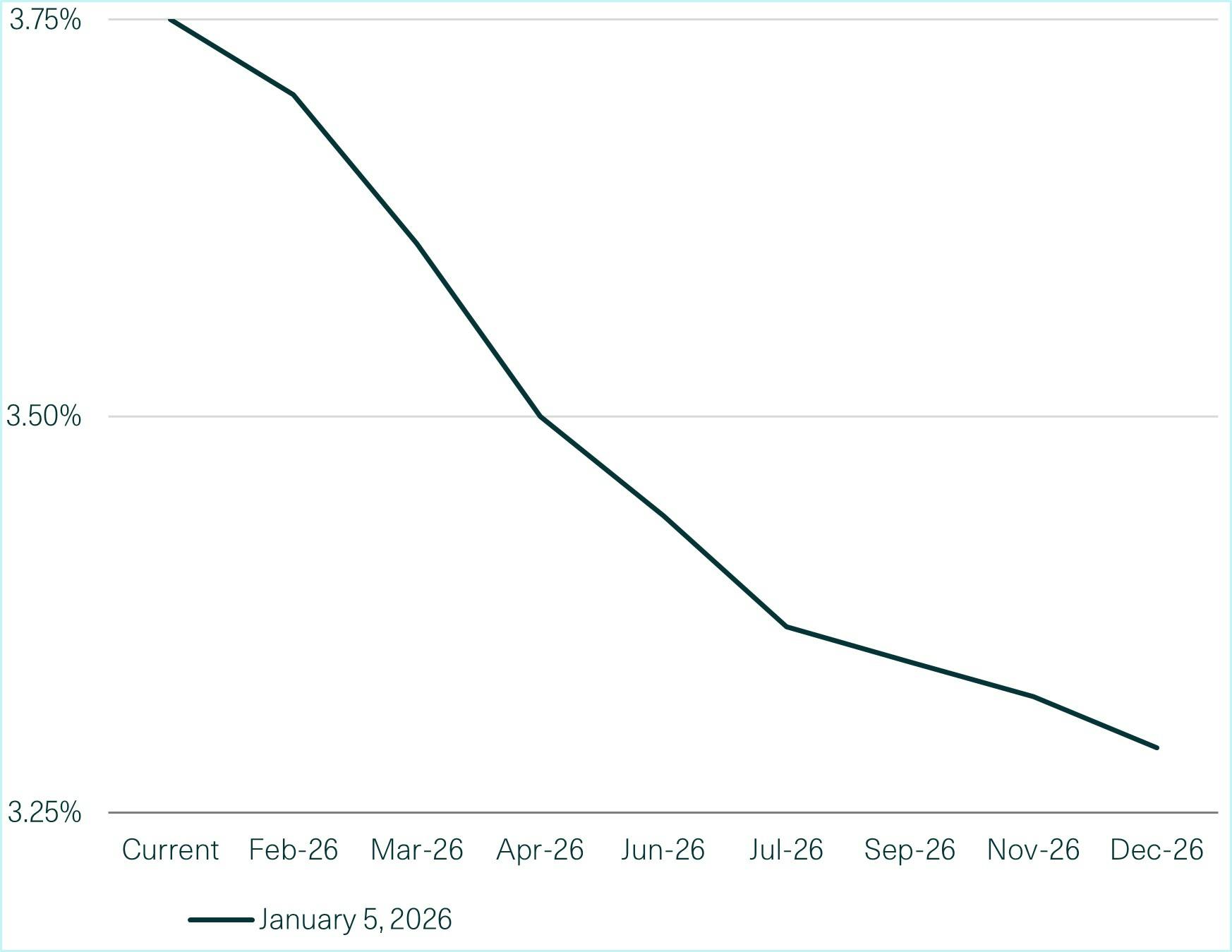
Source: Bloomberg, W1M. As at 27.11.25
Implied US Fed Funds Rate (%)
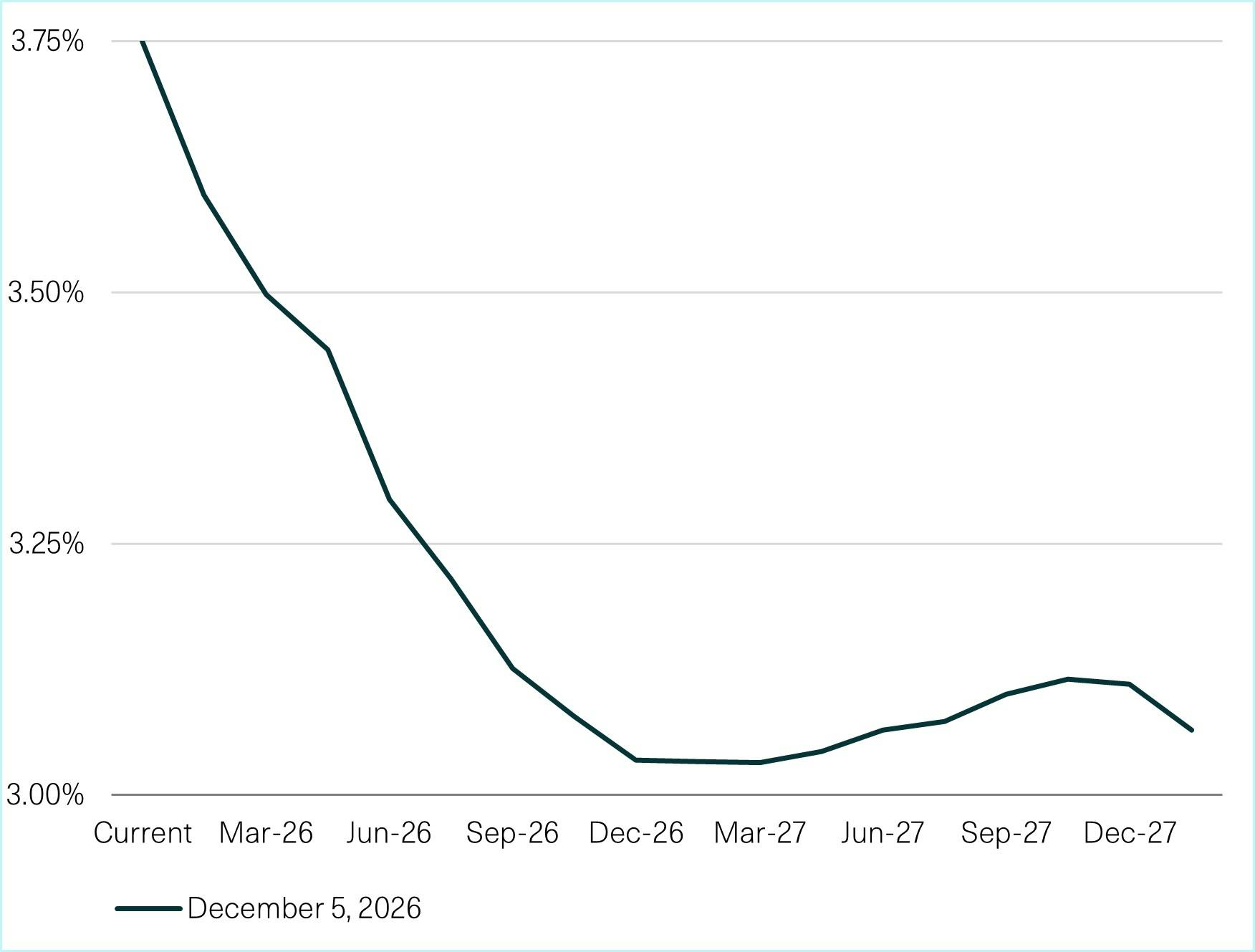
Source: Bloomberg, W1M. As at 27.11.25
AI bubbles?
Nvidia, the leading AI chip designer currently, got to a market value greater than the German economy last year; that could be incredibly unrealistic or too low if it continues to dominate with its technology and, importantly, generates profits to justify its valuation; we are not sure anybody knows the answer to whether it is ridiculously expensive or undervalued currently, but we find other ways to invest in the “AI” theme which is undeniably interesting and transformative. Questions remain about the sums being invested and which companies will be the winners but, for now, optimism dominates. Importantly, the global equity rally last year was not US or tech led; there was also a broader rally in which Emerging Markets, Europe and the UK outperformed US equities over the year. However, around a third of US equity and about a fifth of global equity market value is taken now by a small group of technology companies and this perhaps underlines the need to be active (selective) in portfolios.
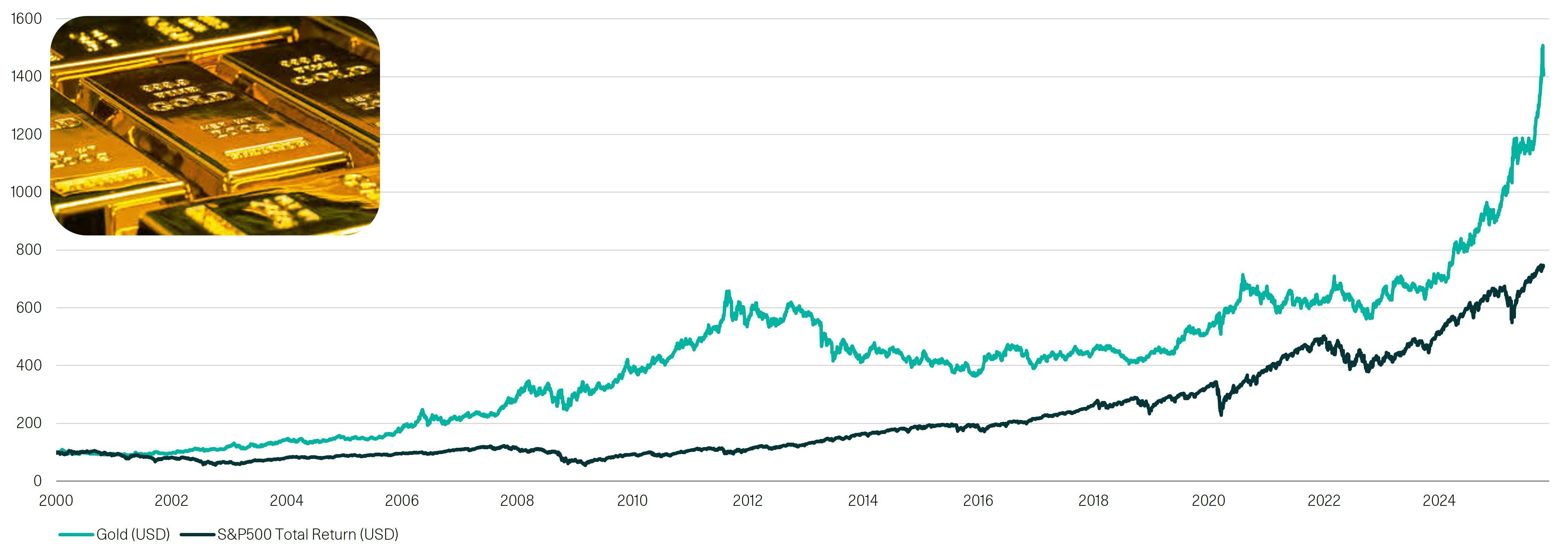
Commodities have gone from being forgotten to getting a lot of attention now; gold and silver, have enjoyed a major bounce while oil has lagged. W1M multi asset portfolios have had a significant real assets component for the diversification and inflation resilience such holdings give. We remain constructive on gold because, despite a sharp increase in price, investors are not necessarily as exposed to it as they now want to be but, more importantly, central banks not wanting to hold as many US dollars as they once did, have been increasing exposure to gold. Other commodities and property also offer interesting opportunities for investors.
Real Assets and Absolute Returns strategies can provide uncorrelated protection against equity risks
Gold has recovered strongly in the 21st century
Source: Bloomberg, Waverton. Data as of 24.10.25
Risk warning: The information above is for example purposes only and should not be considered a solicitation to buy or an offer to sell a security. It is based on our current view of markets and is subject to change. Past performance is no guarantee of future results and the value and income from such investments and their strategies may fall as well as rise. You may not get back your initial investment. Capital security is not guaranteed.
Protection Strategies and Absolute Return
Given the only thing investors can be certain of is that markets will fluctuate, and potentially significantly for short periods, we retain, in W1M multi asset solutions, strategies aimed at protecting portfolios in market turmoil. There could be shocks to growth and inflation prospects ahead; nobody quite knows. The motivation for using proprietary protection strategies is similar to buying home insurance; we hope not to need them but if there is unexpected volatility, which is detrimental to portfolios, we actively take positions which seek to mitigate those risks.
Conclusion
There are always reasons to be cautious. Ignoring short-term news has worked very well for the long-term global investor, despite dips along the way. Markets being around highs is not necessarily a reason to be cautious if corporate earnings are growing and interest rates are falling. Crashes are rare events; equity indices reaching new highs is actually quite normal. Positioning negatively and hoping for a crash is, not in our view, a great strategy. Similarly, owning every stock regardless of its valuation is not necessarily a good strategy, especially when some stocks are pricing in incredible growth which may not be delivered. We remain convinced it is right to be active in an environment where a small number of stocks now represent a significant part of the total market and geopolitical risks persist; our long term track record through various cycles shows the value of being active. We remain positively positioned in the equities we select because the big picture, growth and interest rate trajectories, remain supportive. Real assets offer diversification and inflation resilience. Bond markets, expecting modest US and UK interest rate cuts in the next year, have upside. Proprietary protection strategies are a valuable and distinctive component of our portfolios in an uncertain world. After a volatile 2025, given geopolitical events already this year but also the many opportunities which exist, in our view the need is clear for investors to be properly diversified, global and active.
Summary of our views
Asset allocation positioning
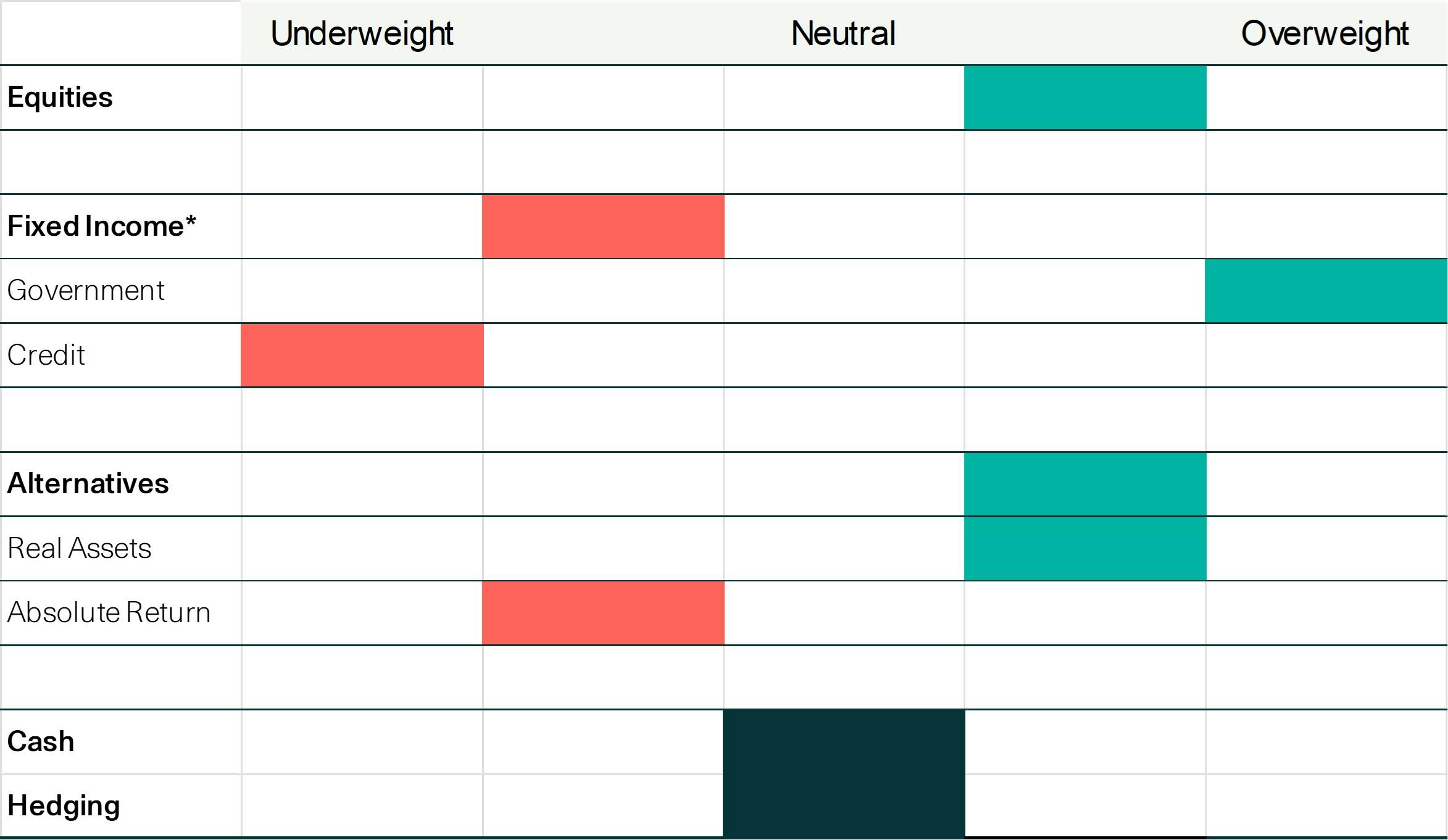
Positively positioned:
– Global growth resilient to challenges so far;
– Inflation expectations remain anchored;
– Interest rate cuts are expected in the US and UK over the next 18 months;
– Sentiment not overly optimistic;
– Valuations not unattractive in most parts of equity markets.
– Government bonds appear more attractive than credit given narrow spreads.
Risks:
– Tariffs are a significant tax increase which could dampen demand.
– If / when the tariffs are passed on to end consumers they could alter the inflation narrative negatively;
Global outlook video from CIO Bill Dining here.
Join us for our quarterly webinar on Tuesday 20th January at 10:00am, hosted by George Bromfield, Head of Adviser Solutions, and William Dinning, Chief Investment Officer.
Together they will discuss the key drivers of portfolio performance, current portfolio positioning, and the global market outlook.
Register here: MPS & Multi-Asset Fund performance update and global outlook Q4 2025
Past performance is not a reliable indicator of future results. The value of investments and the income derived from them may rise as well as fall, and investors may not get back the amount originally invested. Capital security is not guaranteed.
This material is provided for informational purposes only and does not constitute investment advice or a recommendation. It should not be considered an offer to buy or sell any financial instrument or security. Any investment should be made based on a full understanding of the relevant documentation, including a private placement memorandum or offering documents where applicable. W1M Wealth Management Limited is authorised and regulated by both by the Financial Conduct Authority of 12 Endeavour Square, London E20 1JN, with firm reference number 120776 and the U.S. Securities and Exchange Commission of 100 F Street, NE Washington, DC 20549, with firm reference number 801-63787. Registered in England and Wales, Company Number 02080604.
All rights reserved. No part of this publication may be reproduced, distributed, or transmitted in any form or by any means, including photocopying, recording, or other electronic or mechanical methods, without prior written permission from W1M Wealth Management Limited.
Copyright © 2025 W1M Wealth Management Limited.